


Acai powder has conquered Europe. It is found in smoothie bowls in Amsterdam, on the shelves of organic shops in Berlin and in fitness recipes in Paris. But behind the purple pot, there is a question that few consumers ask — and that makes all the difference: how was this powder produced?
There are two main drying processes on the market: freeze-drying and spray-drying. Both remove water from acai pulp to create a stable product that is easy to transport, but the method used directly impacts the flavour, colour, texture and composition of the final product.
After all, What Is Freeze-Dried Acai?
If you are reading this article for the first time, it is quite likely that you have already seen the term “freeze-dried acai” on some label or website without knowing exactly what it means. It is worth explaining carefully before comparing the processes.
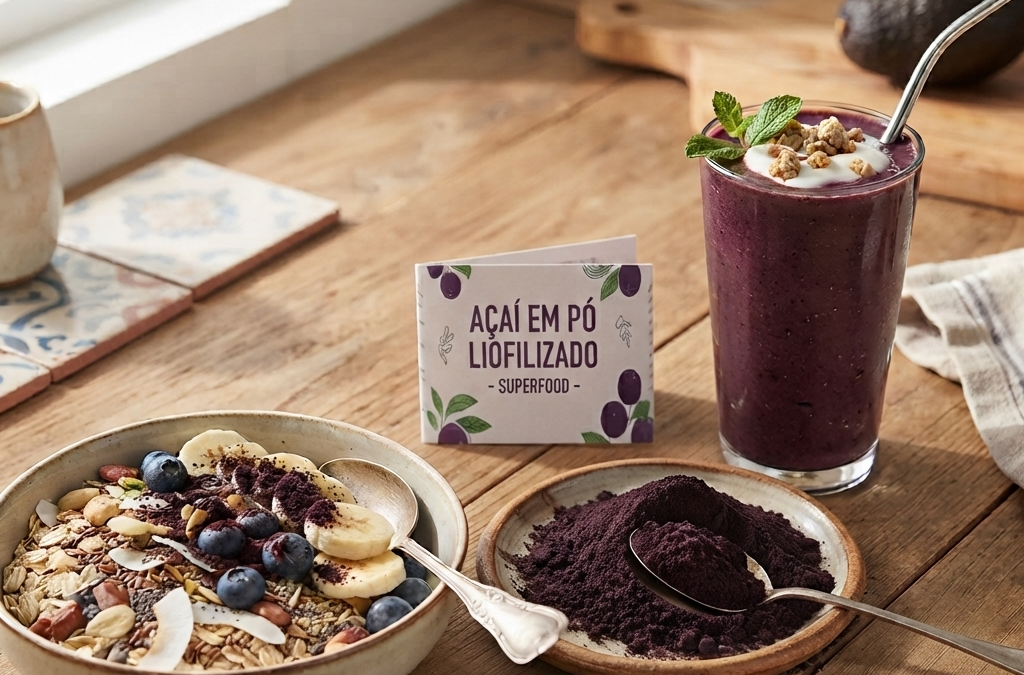
Acai (Euterpe oleracea) is a small purple fruit native to the Amazon region, traditionally consumed in the form of pulp. Since the fruit deteriorates rapidly after harvest, it must undergo some conservation process to be transported and sold outside Brazil — hence the existence of frozen pulp versions, concentrated juice and, of course, powder. “Freeze-dried” is simply the result of the freeze-drying process described below: the fruit pulp transformed into a fine, stable powder, without the need for refrigeration.
From a compositional standpoint, acai is a fruit with a good fat content (which makes it relatively high in calories for a fruit), in addition to providing carbohydrates, fibre, protein, vitamins and bioactive compounds, such as anthocyanins and other polyphenols — the pigments responsible for its characteristic purple colour. It is important to note that the scientific community does not have a rigid technical definition for the term “superfood”, frequently used in the marketing of products such as acai.
Interest in this type of product has also grown outside Brazil: in recent years, acai has gained space in international markets, especially in Europe and the United States, driven by demand for naturally sourced foods. This movement has led health food chains and specialist shops to expand their offering of products derived from the fruit — from the traditional “bowl” to powder versions, convenient for everyday use.
Fun fact: scientific interest in acai goes beyond the pulp. Research from the Faculty of Food Engineering at Unicamp investigated the use of roasted acai pits — currently discarded as waste — to extract inulin, a soluble fibre, resulting in an experimental “acai coffee”. It is a different by-product from the lyophilised pulp powder used in this article, but it shows how the Amazonian fruit continues to be the subject of research.
What Is Freeze-Drying?
Freeze-drying is a cold dehydration process. Acai pulp is first frozen and then subjected to a vacuum, which causes water to go directly from the solid state to the gaseous state — a process called sublimation — without ever passing through the liquid state.
Because the temperature remains low throughout the process, the cellular structure of the fruit undergoes fewer thermal changes. This typically results in:
- 100% fruit powder, with no need for drying agents such as maltodextrin
- Colour closer to the natural deep purple of acai
- Flavour closer to fresh pulp
- Greater stability of heat-sensitive compounds, such as vitamin C and anthocyanins (the pigments responsible for the fruit’s purple colour)
The process is slower and energetically more expensive, which is usually reflected in the final price of the product.
What Is Spray-Drying?
In spray-drying, acai pulp (usually already diluted) is sprayed into fine droplets inside a chamber with hot air, between 150°C and 200°C. The water evaporates almost instantly, leaving only the powder.
It is a quick and economically more efficient process on a large scale, but it has two important technical consequences:
- Exposure to high temperatures tends to degrade heat-sensitive compounds more intensely than freeze-drying does
- Because of the high fibre and fat content of acai pulp, it is common to add maltodextrin or other carrier agents so that the fruit can be sprayed correctly — which dilutes the concentration of pure fruit in the final product
Freeze-Dried vs Spray-Dried: Direct Comparison
| Criterion | Freeze-Dried | Spray-Dried |
|---|---|---|
| Process temperature | Low (freezing + vacuum) | High (150–200°C) |
| Need for additives (maltodextrin) | Generally no | Often yes |
| Colour | More intense purple | Tends to be more opaque/brownish |
| Flavour | Closer to fresh fruit | More neutral |
| Solubility | Good | Very good |
| Production cost | Higher | Lower |
| Consumer price | Higher | More affordable |
Neither of the two methods is “wrong” — the choice depends on what you value: a product as close as possible to the fruit in its natural state, or a more economical option for everyday use.
And the Regulatory Question in the European Union?
A point that raises doubts among consumers is whether acai needs special authorisation to be sold in the EU, since it is a “new” Amazonian fruit for the European palate. The answer is no: acai (Euterpe oleracea) is not classified as a Novel Food by the European Commission, as it has a recognised history of consumption. This means that any operator can legally market it in the EU, as long as it complies with general food labelling and safety rules — which is already observed by reputable suppliers including Viva o Sabor.
Our Choice at Viva o Sabor
We have chosen to work with freeze-dried acai precisely because of our commitment to a product close to the original fruit, without the need for additional drying agents. If you want to experience this difference, meet our Freeze-Dried Acai Amazonas — 100% pure, EU organic certified, with fast delivery throughout Europe.
Sources consulted: Hospital Israelita Albert Einstein (einstein.br), Jornal da Unicamp (jornal.unicamp.br), European Commission — Food Safety (food.ec.europa.eu), Finnish Food Authority (ruokavirasto.fi).
This content is informative in nature and does not replace the nutritional and composition information contained on the label of the product purchased. Always consult the packaging for specific data.